Affordable Hotels in Fukuoka Under ¥15,000 — Where Budget Doesn't Mean Bad
Under ¥15,000 per room per night is the budget tier in Fukuoka — and that threshold covers a real range of hotels, from newly built design properties to older business standards. This guide identifies which ones hold up under scrutiny, and which trade-offs each requires.
Last updated: May 2026

Curated Google My Map — third-party cookies may be set by Google; see privacy policy.
Under ¥15,000 per room per night is the budget tier in Fukuoka — and it covers more ground than most travelers expect. The hotels that hold up in this range are newer business properties built after 2015, established chains with strong operational standards, and a handful of boutique picks that trade station proximity for more space. The ones that disappoint share a recognizable pattern: older building stock, unit baths with visible age, thin walls, and variable English support. This guide identifies which properties clear the bar and what each requires you to accept.
The short version
| Hotel | Off-peak from | Off-peak typical | Smallest room m² | Breakfast | Walk to subway | Booking score |
|---|---|---|---|---|---|---|
| The B Hakata | ¥8,500 | ¥9k–¥12k | 15 | Paid ¥1,650 | 5–8 min (Hakata) | 8.1 |
| Hotel Forza Hakataeki Chikushi-Guchi II | ¥10,000 | ¥11k–¥14k | 18 | Paid ¥1,800 | 3 min (Hakata) | 8.6 |
| Nest Hotel Hakata Station | ¥9,000 | ¥9.5k–¥12.5k | 13 | Paid ¥1,300 | 5 min (Hakata) | 8.0 |
| Comfort Inn Fukuoka Tenjin | ¥8,000 | ¥8.5k–¥11k | 13 | Included free | 1 min (Tenjin Minami) | 7.9 |
| Richmond Hotel Fukuoka Tenjin | ¥11,000 | ¥12k–¥15.5k | 15 | Paid ¥1,500 | 3 min (Tenjin Minami) | 8.4 |
| Hotel Monte Hermana Fukuoka | ¥9,000 | ¥10k–¥13k | 15 | Paid ¥1,800 | 2 min (Watanabe-dori) | 8.2 |
| Hotel Wa Hakata | ¥8,000 | ¥9k–¥12k | 16 | Not available | 3 min (Gofukumachi) | 8.4 |
All off-peak rates are autumn/winter weekday. Weekend nights (Friday/Saturday) add ¥2,500–¥4,000 across all properties. Peak-season rates during Yamakasa (July 1–15), cherry blossom, and Golden Week are a separate category — expect 2x–3x, and the ¥15,000 ceiling effectively ceases to apply.
What ¥15,000 actually buys you in Fukuoka
Travelers expecting the ¥15,000 ceiling to deliver the same experience as a ¥25,000 hotel will be disappointed. What it reliably delivers, across the properties in this guide:
Room size: Standard singles in the budget tier run 13–18 m². Most of that range is perfectly functional for one person with standard luggage. The 13 m² floor (Comfort Inn, Nest Hotel) is tight with two large suitcases — you will leave one closed upright or ask the front desk to store it.
Bathroom: Unit bath is the default under ¥12,000. Toilet, sink, and tub share a modular plastic shell — clean, functional, and showing age at older properties. Forza Hakataeki Chikushi-Guchi II is the exception, with separated wet/dry bathrooms in most room categories.
Sound insulation: Variable by property. Reviews consistently note that Forza II and Richmond Hotel Fukuoka Tenjin offer good insulation. Nest Hotel receives notes about hallway noise; Comfort Inn Tenjin about thin walls between rooms.
Breakfast: Not included in the rate at most properties. Paid breakfasts run ¥1,300–¥1,800 and are Japanese-style buffets. Comfort Inn Fukuoka Tenjin is the outlier — breakfast is included in the rate, which meaningfully changes the effective cost per night.
English support: Chain hotels (Comfort, Richmond, the b hakata) provide consistent adequate English. Newer properties with self-check-in kiosks (Forza II, Nest Hotel) supplement variable desk English with reliable multilingual digital interfaces.
Payment: All properties in this guide accept Visa, Mastercard, and major Japanese credit cards. WeChat Pay and Alipay are accepted at the b hakata and most major portals. Cash-only at check-in is no longer a standard requirement at any of these properties.
The mid-design picks
These two properties occupy the upper end of the budget tier — ¥10,000–¥14,000 off-peak — and justify the premium with newer builds, better sound insulation, and room finishes that feel a tier above their price.

Hotel Forza Hakataeki Chikushi-Guchi II
Built in 2020 and three minutes from Hakata Station’s Chikushi exit, Forza II is the most complete hotel in this guide for the budget tier. Separated wet/dry bathrooms appear in most room categories — genuinely rare under ¥15,000 in Japan. In-room iPad controls are the design touch that reviewers consistently cite; the lobbies are contemporary without the self-consciously minimal aesthetic that makes some design hotels feel cold. Booking score is 8.6 across 800+ reviews, with Agoda at 8.8 — the highest scores of any property in this guide. Honest trade-offs: weekend pricing climbs fast (+¥4,000 Fri/Sat), breakfast lines during peak periods, and elevator wait times during morning checkout rush. Demand note: smallest 18 m² standard doubles are the first category to fill — they book out 3–4 weeks ahead in autumn and during Yamakasa.

Nest Hotel Hakata Station
Built in 2018 and five minutes from Hakata Station’s Hakata exit (west side), Nest Hotel targets travelers who want the look of a design hotel at a business hotel price. The minimalist lobby and muted palette photograph well; bedding quality is consistently cited positively. Rooms start at 13 m² — on the tight end — and the unit baths receive honest notes about size in reviews. Hallway noise is flagged in a portion of reviews, more than at Forza II. Booking score is 8.0 across 2,000+ reviews, Agoda 8.3 across 2,500+. Best position for travelers arriving at or departing from the Hakata-guchi (west) side of the station. Demand note: single rooms at 13 m² fill early during autumn foliage weekends — book 4+ weeks ahead if the stay spans a Saturday night.
The classic budget pick
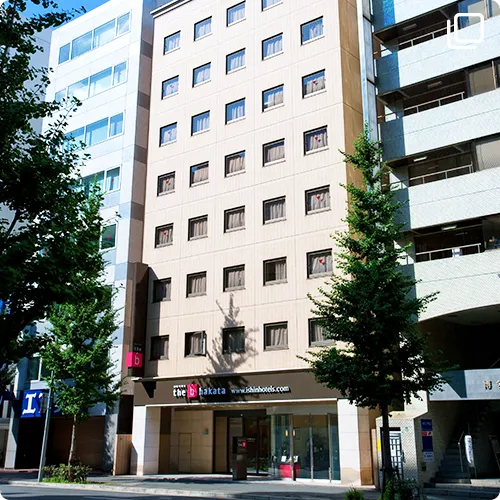
the b hakata
The reference point for budget stays near Hakata Station. Five to eight minutes south of the Chikushi exit, in the quieter Hakataeki-minami residential and office blocks. The lobby tottette service — free coffee, pastry, and a rotating small snack daily from 15:00 to 19:00 — is the feature that appears in the most positive reviews. A 24-hour Matsuya beef-bowl restaurant sits on the building’s ground floor, useful for late arrivals. Rooms start at 15 m² (slightly more workable than the 13 m² floor at Comfort Inn and Nest Hotel), with standard twins at 18 m². Unit baths; older fixtures noted in some reviews alongside an acknowledgment that they are clean. Booking score 8.1 across 1,500+ reviews; Agoda 8.2 across 2,000+. For travelers who value walk-in value — free lobby food, on-site 24h dining, clean and reliable — the b hakata is the consistent first recommendation at this price. Demand note: standard double and twin rooms at this price point fill 3–4 weeks ahead during autumn and Yamakasa season; single rooms are slightly more available.
The Tenjin budget picks
For travelers whose itinerary centers on Tenjin — shopping at Daimaru, Iwataya, or the Tenjin Underground Mall; dining in Daimyo or Imaizumi; the Nishitetsu Tenjin–Dazaifu line for day trips — the Hakata Station hotels add 10–12 minutes of daily subway transit that accumulates across a multi-day stay. Two properties cover the Tenjin side of the budget tier.

Comfort Inn Fukuoka Tenjin
One minute from Tenjin-minami Station (Nanakuma Line Exit 5) and the only property in this guide with breakfast already in the rate. The breakfast is a sit-down Komeda’s Coffee set — five menu options including the signature ogura red bean toast — served on the ground-floor café from 06:30 to 11:00 at ¥990 face value. For a solo traveler at ¥8,000–¥9,000 off-peak, that built-in cost closes most of the gap to pricier properties where breakfast is a separate ¥1,300–¥1,800 add-on. Rooms start at 12–13 m² (the smallest floor in this guide) and thin inter-room walls are noted consistently enough to matter for light sleepers. On the transit side, the Tenjin-minami connection reaches Hakata Station in 3 minutes (¥210) and FUK Domestic Terminal in ~16 minutes — the strongest airport-to-hotel transit score of any Tenjin property. Booking 8.3 / 2,870 reviews; Agoda 8.4 / 3,500 reviews.

Richmond Hotel Fukuoka Tenjin
Sits three minutes from Tenjin-minami Station on Watanabe-dori — the most reliable chain name at the upper end of the Tenjin budget tier. Off-peak rates run ¥12,000–¥15,500, pressing the ¥15,000 ceiling on many nights, but Richmond justifies the stretch: cleanliness scores are among the highest in this guide, sound insulation is consistently praised, and the free lobby amenity bar (skincare sets, bath salts, premium drip coffee) is a value add that no sub-¥15,000 competitor in Fukuoka matches. Rooms start at 18 m² with unit baths. Breakfast is paid at ¥1,500, Japanese-style buffet. For solo female travelers, Richmond is one of two properties in this guide that operates a dedicated women’s floor with elevator keycard access. The honest caveat: weekend nights regularly exceed ¥15,000 — verify your specific dates before treating it as a budget pick. Coin laundry on-site.
The Watanabe-dori value pick

Hotel Monte Hermana Fukuoka
Monte Hermana sits 2–3 minutes from Watanabe-dori Station on the Nanakuma Line — a transit connection that makes Hakata Station 5 minutes away by subway (since the 2023 Hakata extension) and Fukuoka Airport roughly 20–25 minutes total. At this price point the defining differentiator is floor space: all 373 rooms run 21–22 m², substantially larger than the 13–15 m² standard in comparable Tenjin-area business hotels — reviewers specifically cite opening two full-size suitcases simultaneously without rearranging furniture. The women-only floor operates card-key elevator restriction with DHC Olive Gold Series amenities; it is the most-cited reason solo female travelers select Monte Hermana over Richmond or Comfort Inn at similar price points. Simmons pocketed coil mattresses and Gunze 100% cotton pajamas are standard across all room types. The Watanabe-dori commercial block quiets after 22:00, making it one of the calmer mid-range options between Tenjin core and Nakasu. Honest trade-offs: the unit baths and European-chic decor are beginning to accumulate minor age notes compared to 2020+ builds, and the breakfast at Bonne Récolte runs ¥3,000 per person — skip it and use nearby convenience stores. Booking 8.4 / 1,298+ reviews; Agoda 8.7 / 17,786+ reviews. Coin laundry on-site.
The Nakasu-side aparthotel

Hotel Wa Hakata
Hotel Wa Hakata is the most different property in this guide. A 27-room, 10-story aparthotel that opened in July 2021 on Tenyamachi — the quiet temple-lined corridor between Hakata Station and Nakasu — it is not near Hakata Station in any meaningful pedestrian sense. The walk from the JR gates to Hotel Wa Hakata is 15–20 minutes with luggage; travelers who don’t verify this before booking are the source of nearly all critical reviews. Set that expectation correctly and what you get is a self-contained apartment hotel rather than a business hotel: Type A 32 m² for up to 4 guests, Type B 39 m² for up to 5, Type C 57 m² for up to 8 across two distinct bedrooms. Every unit includes a full kitchen with two IH burners, cookware and tableware, a microwave, a mid-sized refrigerator/freezer, and a private in-unit washing machine with bathroom drying vent — the standard equipment list that separates serviced apartments from conventional hotels. Bathrooms are residential-style separated (toilet, shower-tub room, and washlet are distinct). For a family of five in a Type B, the per-person nightly rate drops to ¥3,000–¥4,000 off-peak — well below the per-person cost of booking three single business hotel rooms. Honest caveats: check-in is unmanned via a multilingual tablet from 15:00 with a 22:00 latest entry cutoff (no luggage drop before 15:00, no staff to call after hours), there is no on-site breakfast, and OTA prepayment is mandatory. Booking 8.7 / 1,000+ reviews; Agoda 8.7 / 1,400+ reviews; Expedia 9.0 / 160+ reviews.
Capsule and hostel alternatives
For travelers willing to go below the ¥15,000 floor — and accept shared or capsule-format sleeping — Fukuoka has several well-reviewed options in the ¥3,000–¥8,000 range.

9h nine hours Hakata
The Fukuoka outpost of Japan’s most design-consistent capsule chain, two minutes from JR Hakata Station’s west exit. The “9h” concept is literal — seven hours sleep, one hour shower, one hour dress — and the pod reflects it: a 105 × 215 × 102 cm FRP shell with adjustable lighting, a TOTO shower system, and a Gymnast Plus pillow, closer to a precision object than a standard capsule unit. Smart check-in terminals handle arrival cashlessly without staff. Men’s and women’s zones are fully separated floor-by-floor. For a solo traveler arriving late off a Shinkansen or early morning FUK flight, it is the most efficient airport-to-bed option in central Fukuoka at this price point. Honest limits: the pod dimensions that some guests find meditative, others find confining; no reception for in-person queries; and locker space cannot accommodate full-size checked luggage. Couples and mixed-gender groups cannot share adjacent pods. Google 4.1 / 1,200+ reviews.
HEARTS Capsule Hotel & Spa includes onsen access in the rate — a meaningful value addition in the Fukuoka capsule market where spa facilities are not universal. Reviews flag it as one of the better-maintained budget properties in the city.
WeBase Hakata operates as a hostel-hotel hybrid with both dormitory and private room options. Private rooms bring it closer to the lower end of business hotel territory; the hostel common areas are cited as the social differentiator for backpackers.
None of these are appropriate for couples or solo travelers with two large suitcases. For a one- or two-night solo stay with minimal luggage, they are the clear value choice in Fukuoka.
Budget red flags to watch for
Honest checklist based on patterns across critical reviews for Fukuoka budget hotels.
Residual smoking smell. Japan’s older business hotel stock allowed indoor smoking in specific rooms for years; the residue persists in older buildings even in designated non-smoking rooms. Booking explicitly as a verified non-smoking room in a newer property (2015+) is the most effective mitigation.
Mold or mildew in unit baths. Unit baths in properties built before 2010 accumulate mold at grout lines and around the tub edge. Reviews that mention bathroom cleanliness specifically — rather than generically — are worth reading closely. The word “musty” in recent reviews is the most reliable signal.
Thin walls between rooms. Sound insulation varies significantly within the budget tier. Properties where this is flagged in recent reviews (Comfort Inn Tenjin, Nest Hotel) are not disqualifying — just a relevant input for light sleepers or couples who want acoustic privacy.
No English at the front desk. Major chains manage this with multilingual kiosks. Smaller boutique properties (Hotel Wa Hakata) rely on basic English at the desk with tablet assistance. This matters more at check-in for travelers with specific room requests; less for standard online-booked stays.
Hidden surcharges. Early check-in fees (¥500–¥2,000), late checkout fees, and in-room amenity charges are standard at most properties. These are not hidden if you read the booking confirmation — they become surprises only when ignored. Coin laundry, vending machine tea, and electric kettle amenities are free at all properties in this guide.
Booking timing for cheapest rates
Cheapest months: January, February, and June (excluding rainy-season weekend spikes) consistently produce the lowest rates across Fukuoka’s budget tier. These are the months when advance booking pressure is lowest and last-minute availability is most likely to yield discounts.
Weekday vs. weekend differential: Friday and Saturday nights add ¥2,500–¥4,000 across all properties in this guide. A Sunday–Thursday stay at a property like Comfort Inn or the b hakata can run meaningfully cheaper per-night than the same hotel on a weekend booking.
Peak season: The ¥15,000 ceiling becomes irrelevant during Hakata Gion Yamakasa (July 1–15), cherry blossom (late March–early April), Golden Week (late April–early May), and Obon (mid-August). Hakata Station-area hotels are particularly affected during Yamakasa, with some properties running 2–3x off-peak rates. Tenjin-side properties are comparatively less affected during festival season — if you are traveling during Yamakasa on a budget, Comfort Inn and Richmond Hotel Fukuoka Tenjin are the more stable-priced options.
Advance booking vs. last-minute: For off-peak weekday stays, last-minute bookings (7–14 days out) occasionally yield slight reductions as hotels manage unsold inventory. For any weekend, autumn, or festival-adjacent stay, 2–3 months advance booking is the safer approach — particularly for the smallest and cheapest room categories, which are the first to fill.
Free or cheap things to do in Fukuoka
A budget hotel stay in Fukuoka pairs well with the city’s genuinely free and low-cost options.
Ohori Park and Maizuru Park. The city’s main green space — a large lake with a pedestrian circuit and a central island — is free and a 10-minute walk from Ohori Koen Station. Maizuru Park (Fukuoka Castle ruins) adjoins it and is the city’s primary cherry blossom site in spring. Both are walkable from Tenjin-side hotels.
Tenjin Underground Mall (Tenjin Chikagai). A 1-kilometer subterranean shopping street connecting Tenjin Station to the Nishitetsu bus terminal. Free to walk, weatherproof, and a full afternoon of window shopping.
Kushida Shrine and Tochoji Temple. Kushida Shrine, between Hakata Station and Nakasu, is free to enter and houses one of the Yamakasa floats year-round. Tochoji Temple, a short walk away, contains Japan’s largest wooden seated Buddha figure — admission is nominal.
Fukuoka City Hall observation deck. The free observation floor on the eighth floor of the Fukuoka City Hall building provides a direct view over the city without the admission fees of the Fukuoka Tower. Worth the subway ride for the perspective.
Yatai food stalls. The Nakasu riverside yatai — and the smaller Tenjin and Nagahama clusters — are not free (a bowl of ramen runs ¥800–¥1,200), but they are among the more affordable sit-down evening experiences in the city, particularly compared to restaurants. The social dynamic of sharing a counter with strangers is the experience, not just the food.
Who should pick which
| Traveler profile | Recommended pick | Reason |
|---|---|---|
| Solo traveler, 1 night, Hakata transit | The b hakata or Nest Hotel | Cheap, clean, close to station; free lobby snack at the b |
| Couple, 2–3 nights, design matters | Hotel Forza Hakataeki Chikushi-Guchi II | Separated bathroom, modern build, best Booking score in tier |
| Kyushu rail loop traveler (Hakata base) | Hotel Forza II or the b hakata | Shinkansen walkability is the priority; both within 5–8 min |
| Breakfast required before 09:00 departure | Comfort Inn Fukuoka Tenjin | Only property with included breakfast; prevents morning surcharge stress |
| Solo female traveler | Richmond Hotel Fukuoka Tenjin or Hotel Monte Hermana | Women-only floors with keycard elevator access at both |
| Light sleeper | Richmond Hotel Fukuoka Tenjin or Hotel Forza II | Consistently strong sound insulation reviews at both |
| Design-conscious traveler, boutique feel | Hotel Wa Hakata | Tatami elements, separated bath, residential quiet — not near Hakata Station |
| Location maximizer (Tenjin access) | Comfort Inn Fukuoka Tenjin | 1 minute from Tenjin-Minami Station; best Tenjin transit position |
| Extended stay (4+ nights) | Hotel Wa Hakata or Hotel Monte Hermana | More room to live in; quieter areas for multi-night comfort |
| Ultra-budget, solo, 1–2 nights | 9h Nine Hours Hakata or WeBase Hakata | Sub-¥7,000 if the capsule/hostel format works |
How to decide
Three questions, sixty seconds.
-
Is Hakata Station the center of your trip — shinkansen departures, airport connection, early morning transit? If yes, choose the b hakata, Hotel Forza II, or Nest Hotel. The compounding daily walk-time saving from station proximity is real.
-
Is free breakfast or a separated bathroom the feature you will notice most? Free breakfast narrows to Comfort Inn Fukuoka Tenjin. Separated bathroom narrows to Hotel Forza II or Hotel Wa Hakata (noting the latter is 15–20 minutes from Hakata Station on foot).
-
Are you traveling on a Friday or Saturday, or during Yamakasa (July 1–15) / cherry blossom / Golden Week? If yes, recalculate — the ¥15,000 ceiling may not hold. Check current rates before narrowing to a pick, and consider whether Tenjin-side options (Comfort Inn, Richmond) offer more date-stable pricing than the Hakata cluster during festival season.
If none of the three questions produces a clear answer, default to the b hakata. The value-to-hassle ratio at ¥8,500–¥12,000 with free lobby snacks, 24h dining on-site, and reliable English support is the least likely to produce a regret.
FAQ
What is a realistic minimum nightly rate for a decent hotel in Fukuoka off-peak?
An honest floor for a clean, safe single room during off-peak weekdays (autumn/winter) is ¥7,000–¥9,000. For a double or twin, the practical floor is ¥10,000–¥13,000. Dropping below ¥7,000 for a private room typically introduces compromises on cleanliness, English support, or building condition, based on aggregated Booking and Agoda review patterns.
Are capsule hotels a good option in Fukuoka, or should I stick to a business hotel?
Capsule hotels — 9h Nine Hours Hakata, HEARTS Capsule Hotel & Spa, WeBase Hakata — are excellent for solo travelers staying one or two nights, with rates around ¥3,000–¥5,000. For couples, travelers with two large suitcases, or anyone staying three nights or more, a business hotel is a much better fit. Locker space in capsule facilities cannot accommodate full-size luggage.
Will my budget hotel in Fukuoka have an English-speaking front desk?
Major chains — Comfort Inn, Richmond, APA, Toyoko Inn, the b hakata — consistently provide adequate English support or use multilingual translation devices. Independent and boutique properties are more variable; many rely on self-check-in kiosks with English toggle. Reviews on Google and Booking flag front-desk language ability in recent reviews — worth checking before booking a smaller property.
How small are budget single rooms in Fukuoka — will my luggage fit?
Budget single rooms in Fukuoka typically measure 10–13 m². One large suitcase opened on the floor is manageable; two full-size pieces is tight. The standard hotel workaround is leaving a second bag at the front desk during the stay — all major properties in this guide offer free luggage storage before check-in and after check-out.
Are budget hotel bathrooms really unit-bath style?
Yes — the large majority of hotels under ¥12,000 use a modular unit bath where toilet, sink, and small tub share one plastic shell. Hotel Forza Hakataeki Chikushi-Guchi II is the exception at this price band, with separated wet/dry bathrooms in most room types. Hotel Wa Hakata also offers separated bath and toilet, though it is not near the main station.
Is breakfast worth paying for at budget hotels in Fukuoka, or is konbini better?
If breakfast is included (Comfort Inn Fukuoka Tenjin), it is worth taking. Budget hotel paid breakfasts range from ¥1,300–¥1,800 and are generally Japanese-style buffets. Experienced travelers frequently skip them in favor of a ¥500 konbini breakfast or a nearby bakery. The calculus changes for travelers who need a hot meal before an early checkout.
How much do hotel prices jump during cherry blossom or Golden Week in Fukuoka?
Rates typically climb 2x–3x above off-peak levels during cherry blossom (late March–early April), Golden Week (late April–early May), Obon (mid-August), and the Hakata Gion Yamakasa festival (July 1–15). A room available for ¥9,000 in February can exceed ¥25,000 during these windows, based on KAYAK historical pricing data. The ¥15,000 budget ceiling effectively disappears during peak periods at most properties.
What is the cheapest way to get from Fukuoka Airport to a budget hotel?
The Fukuoka City Subway Kuko Line is the most cost-effective option — ¥260 flat fare, five minutes to Hakata Station, eleven minutes to Tenjin Station. The airport bus runs ¥330 to the city center but is subject to traffic delays. Taxis from FUK to Hakata Station run ¥1,500–¥2,000, rarely justified when the subway is a four-minute walk from the domestic terminal.
Are there safe budget hotels for solo female travelers in Fukuoka?
Hakata and Tenjin business hotels are among the safest urban stays in Japan for solo women. Richmond Hotel Fukuoka Tenjin and Hotel Monte Hermana Fukuoka both operate dedicated women-only floors with elevator keycard access. The broader hotel stock in both districts is consistently rated as safe across Booking and Agoda reviews from female solo travelers.
What red flags should I look for in budget hotel reviews?
The most-flagged issues across Booking and Agoda critical reviews for Fukuoka budget hotels — in order of frequency — are residual smoking smell (book a verified non-smoking room), mold or mildew in unit bathrooms, hallway noise through thin walls, slow or broken elevators, no English at the front desk, and hidden surcharges for early check-in or late checkout. Searching recent reviews for these terms before booking takes under two minutes and catches most of the avoidable disappointments.
Read next
- Best Hotels Near Hakata Station — Your Gateway to Kyushu
- Hakata vs Tenjin — Where to Stay in Fukuoka
- First-Time Fukuoka — What to Know Before You Book